
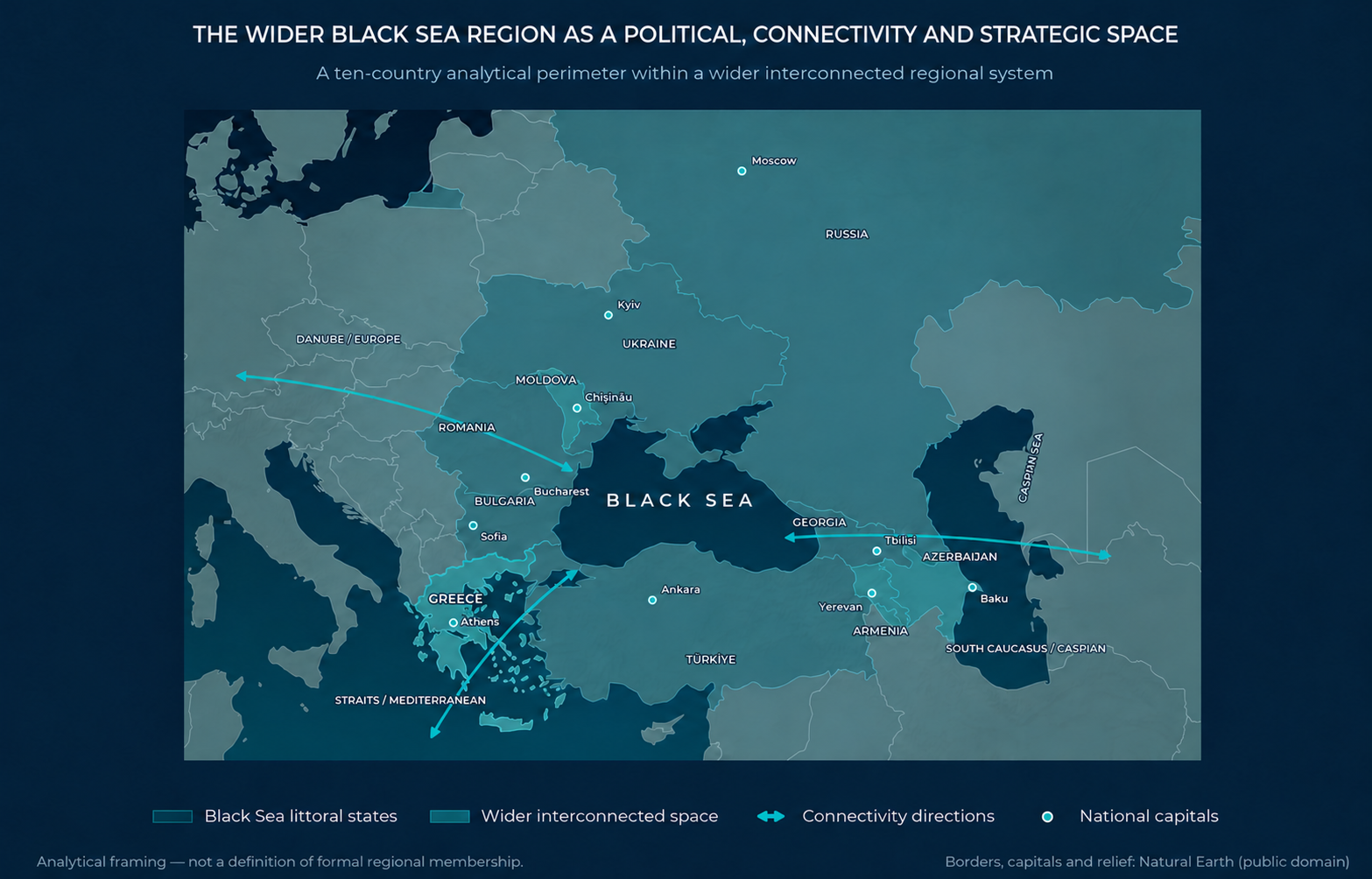
What exactly does the Black Sea region encompass? Is it simply the six countries bordering the sea? Or should we also consider the political, economic, security and connectivity systems that extend well beyond its coastline?
The answer depends on how we approach the region, what we are looking for, and which connections we consider relevant.
Black Sea Futures has published its first foundational analysis, The Wider Black Sea Region in Policy Frameworks, 1992–2026, examining how successive EU and non-EU policy frameworks have conceptualised the region over more than three decades.
Drawing on 23 policy frameworks, organised into four historical periods, the study traces the evolution of political, economic, connectivity and strategic approaches to the Black Sea region, from the post-Soviet period to 2026.
One of its central observations is that the region’s policy geography has not evolved through a single, progressively expanding boundary. Different regional configurations have emerged, overlapped and changed in response to evolving institutional priorities and geopolitical circumstances.
Why does this matter for Black Sea Futures?
Black Sea Futures naturally approaches the wider Black Sea region as a political and connectivity space encompassing ten countries: Armenia, Azerbaijan, Bulgaria, Georgia, Greece, Moldova, Romania, Russia, Türkiye and Ukraine.
This analytical perimeter draws on the policy frameworks examined in the study, while recognising that the region has always been connected to neighbouring geographical and strategic spaces.
The wider Black Sea region is therefore more than a collection of countries or a geographical area surrounding a sea. It is also, perhaps more than anything, a space shaped by interconnected systems, overlapping regional arrangements and relationships that extend beyond its immediate boundaries.
The publication includes a chronological inventory of the policy frameworks examined, an interactive table allowing readers to explore EU and non-EU approaches, and a downloadable PDF.
Explore the full analysis: The Wider Black Sea Region in Policy Frameworks, 1992–2026 →