
Black Sea Futures · Foundational analysis
The Wider Black Sea Region
in Policy Frameworks 1992–2026
An analytical inventory of evolving political, economic, connectivity and strategic approaches.
An evidence-based overview of how the wider Black Sea region has been conceptualised over time and how this informed the Black Sea Futures project’s approach and analytical perimeter.
Overview
This analytical overview maps 23 policy frameworks established between 1992 and 15 April 2026 to examine how the wider Black Sea region has been conceptualised and approached as a maritime basin, political and economic cooperation area, security environment and connectivity space. The chronological inventory compares their geographical scope, purpose and, above all, distinctive contribution to regional policy thinking.
The evidence reveals overlapping rather than uniformly expanding regional geographies: a wider-than-littoral conception was present in the 1990s, while EU enlargement and successive security crises reconfigured cooperation and strategic priorities. On this basis, and looking at the wider Black Sea region, the Black Sea Futures project adopts a ten-country analytical perimeter, supported by both multilateral regional practice and explicit EU definitions in 1997 and 2007. Russia equally remains within the project’s analytical scope, despite its exclusion from the EU’s Strategic Approach to the Black Sea region adopted in 2025, for obvious reasons.
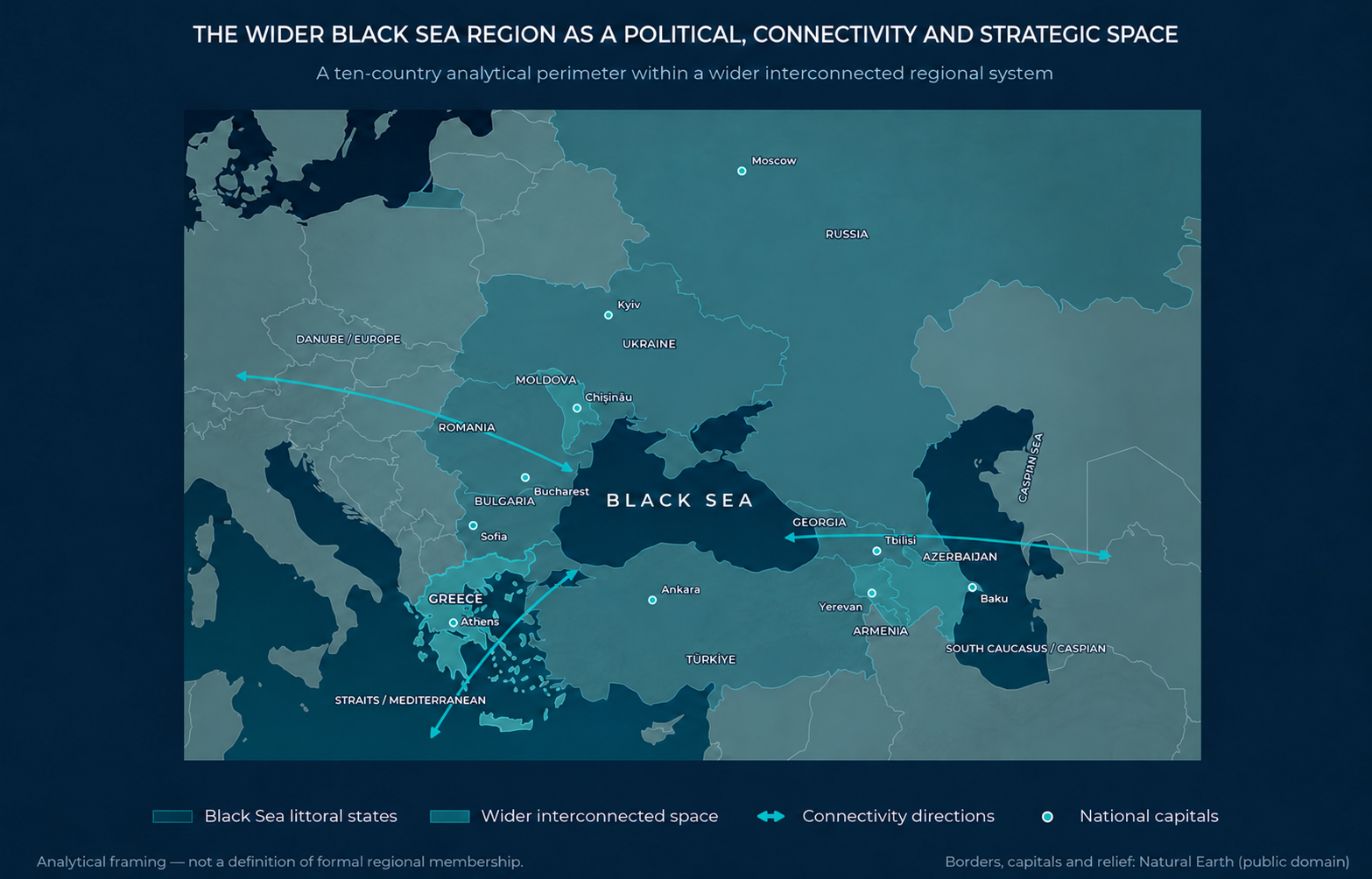
The Black Sea Futures project (hereafter the BSF project) approaches the wider Black Sea region as a political and connectivity space encompassing ten countries: Armenia, Azerbaijan, Bulgaria, Georgia, Greece, the Republic of Moldova, Romania, Russia, Türkiye and Ukraine.
This ten-country analytical perimeter draws on the policy frameworks examined in this study. Analytical inclusion in the BSF project takes into account the entire set of policy definitions and approaches to the region and is distinct from membership of any one particular organisation or cooperation framework, even where these overlap.
01Consolidated chronological inventory of policy frameworks
This selective inventory examines how the wider Black Sea region has been conceptualised and approached since 1992, without assuming a single universally accepted boundary. It covers Black Sea-specific frameworks, overlapping political and sectoral arrangements, and connectivity initiatives linking the region with adjacent spaces. For each framework, it identifies institutional origin, geographical scope, objectives, distinctive contribution and a numbered documentary source (Section 6). Adoption, membership and operational implementation are distinguished where relevant. The four periods support comparative interpretation rather than implying linear progress or automatic causation. Evidence cut-off: 15 April 2026.
The filters distinguish EU institutional and EU-initiated policy instruments from independent, treaty-based and jointly owned regional processes. EU funding or support alone does not make a regional framework an EU instrument. The 1993 TRACECA programme is classified by its EU origin; the Energy Community, Common Maritime Agenda and regional scientific agenda retain their joint or regional character.
02Interpreting the four periods: evolution without one expanding boundary
2.1. 1992–2003 | Parallel maritime, political-economic and connectivity conceptions
The 1992 Bucharest Convention treated the sea as a shared environmental basin of six littoral countries. The BSEC founding declaration in the same year established a wider eleven-country economic cooperation initiative: the ten states of the wider Black Sea region – Armenia, Azerbaijan, Bulgaria, Georgia, Greece, the Republic of Moldova, Romania, Russia, Türkiye and Ukraine – whose grouping was later adopted by the BSF project, together with Albania. The BSEC Charter, in force from 1999, defines its institutional region by member-state territories. PABSEC and BSTDB subsequently provided parliamentary and finance mechanisms within that wider cooperative tradition. [1–5]
TRACECA’s 1993 origin shows that the interregional connectivity perspective was present from the beginning: the South Caucasus, Caspian and Central Asia were connected to Europe through a transport-corridor logic. GUAM provided a narrower political arrangement, while BLACKSEAFOR reaffirmed the six-state naval geography. These were parallel responses to different needs, not stages in the growth of one regional boundary. [4, 7–8]
The Commission’s 1997 communication is particularly revealing. Paragraph 5 explicitly lists the ten countries of the wider Black Sea region – Armenia, Azerbaijan, Bulgaria, Georgia, Greece, the Republic of Moldova, Romania, Russia, Türkiye and Ukraine – although footnote 2 confines the Russian geographical component to Black Sea-adjacent oblasts. Paragraph 6 treats the region as a trade link between Europe, Central Asia and the Middle East. The political and connectivity perspectives thus pre-date Black Sea Synergy by a decade. [6]
2.2. 2004–2013 | Policy differentiation and regional cooperation at several levels
The EU’s 2004 and 2007 enlargements changed its relationship to the region. The ENP created bilateral neighbourhood relationships, while the Energy Community introduced legal and regulatory cooperation across a wider, evolving energy area. Neither establishes a universal Black Sea perimeter. [9–10]
The 2006 Black Sea Forum declaration brought together nine signatory states – the ten countries of the wider Black Sea region excluding Russia – while Russian officials attended as observers. The 2007 Black Sea Synergy reaffirmed the ten-country political region, including Russia and Greece. The Council of Europe-supported Black Sea Euroregion, launched in 2008, approached cooperation instead through local and regional authorities: its statutes envisaged twelve countries, but founders came from five. [11–13]
The 2008 Black Sea Basin programme illustrated a practical distinction: an initial announcement envisaged ten participating countries, whereas the operational programme involved eight. The 2009 Eastern Partnership then created an overlapping eastern political framework also including Belarus. Regional definition, treaty membership and programme participation should therefore not be conflated. [14–15, 25]
2.3. 2014–2021 | Security reappraisal alongside sectoral cooperation
Russia’s annexation of Crimea in 2014 and the conflict in eastern Ukraine significantly changed the security environment. NATO’s 2016 Warsaw Communiqué explicitly addressed the deterioration of Black Sea security and reinforced deterrence and defence measures in the south-east. Meanwhile, the 2019 Common Maritime Agenda and its scientific strand continued sectoral cooperation among the six littoral states and Moldova. Different institutions were therefore moving in different directions. [16–18]
The Council of the EU’s 2019 conclusions emphasised strategic importance, security challenges, resilience and connectivity while retaining Black Sea Synergy as the basis for regional cooperation. Global Gateway, launched in 2021, subsequently provided a global investment and connectivity lens, not a new geographical definition of the Black Sea. These frameworks illustrate increasing strategic attention without demonstrating corresponding institutional convergence. [19–20]
2.4. 2022–15 April 2026 | Geopolitical rupture and strategic consolidation
Russia’s full-scale invasion of Ukraine in 2022 reconfigured the conditions for regional cooperation. The Interreg NEXT Black Sea Basin programme includes eight participating states but excludes Russia. This changes operational cooperation, not the reality of geographical or security interdependencies. [21]
The 2024 TEN-T revision strengthened the framing of Black Sea links as part of European multimodal corridors. The EU’s 2024 review of Black Sea Synergy also addressed the changed context for regional cooperation. These developments prepared the ground for renewed strategic attention, although no direct causal chain should be presumed. [22, 26]
The EU Strategic Approach to the Black Sea region of 28 May 2025 integrates security, stability, resilience, prosperity, environmental preparedness and a proposed regional Connectivity Agenda. Its footnote 2 adopts a nine-country policy perimeter including Greece and excluding Russia. The Connectivity Agenda was already proposed in May 2025 and is on a path of implementation. Its subsequent steps and implementation beyond this inventory’s 15 April 2026 cut-off will be analysed in future studies under the Black Sea Futures project’s umbrella. [23]
03Main findings of the documentary inventory
Finding 1 – A wider-than-littoral concept is historically established. In 1992 the six-country environmental convention and eleven-founder BSEC initiative coexisted; in 1997 the Commission explicitly listed the ten countries of the wider Black Sea region. The broader regional idea is not a recent invention.
Finding 2 – Different policies create different regions. Environmental management, investment, parliamentary dialogue, energy law, maritime activity, territorial funding and defence produce overlapping but non-identical geographical arrangements.
Finding 3 – Connectivity is foundational. The 1993 TRACECA initiative and BSTDB’s financial remit show that corridors, trade and investment links have long shaped the regional concept; later EU initiatives reinterpret and extend that logic.
Finding 4 – Strategic and security interpretations became more explicit following 2014. NATO’s 2016 Black Sea provisions and the Council of the EU’s 2019 conclusions document heightened security, resilience and connectivity attention; broader ambition alone does not prove coherence or implementation.
Finding 5 – Political participation differs from analytical inclusion. The EU’s exclusion of Russia from cooperation frameworks after 2022 and from the 2025 Strategic Approach to the Black Sea region does not remove Russia from the relevant maritime, geopolitical or security analysis.
Finding 6 – Greece has a continuous documentary role. It is present in BSEC, BSTDB and the European Commission’s 1997, 2007 and 2025 Black Sea frameworks. Its place in the BSF project’s analytical perimeter is firmly grounded.
04Regional policy conceptions beyond the European Union
The understanding of the Black Sea as a wider political and connectivity space is not confined to EU policy. It is rooted in multilateral cooperation beginning with BSEC in 1992 and extending to parliamentary cooperation, development finance, maritime security arrangements, regional political dialogue and subnational cooperation.
These arrangements use different geographical perimeters according to their functions. Together they provide substantial documentary grounds for studying the Black Sea beyond its six littoral states, without establishing a universally binding definition.
BSEC remains the clearest independent political-economic precedent; BSTDB and PABSEC operationalise related cooperation through finance and parliaments. The 2008 Black Sea Euroregion represents an additional, Council of Europe-supported subnational perspective, but statutory openness to twelve states must not be confused with the five countries represented among its founders. GUAM, the 2006 Forum and BLACKSEAFOR are useful counterexamples of narrower functional and political boundaries. [2–5, 7–8, 11, 13]
Albania, Serbia and North Macedonia are relevant when documenting wider institutional memberships. None is included in the BSF project’s ten-country analytical perimeter simply by virtue of participation in a wider organisation. The selection of countries serves the particular historical, political, geopolitical and connectivity questions the BSF project intends to study.
05Black Sea Futures – working definition
The Black Sea Futures project approaches the wider Black Sea region as a political and connectivity space encompassing ten countries: Armenia, Azerbaijan, Bulgaria, Georgia, Greece, the Republic of Moldova, Romania, Russia, Türkiye and Ukraine.
This definition extends beyond the six littoral states to reflect the region’s historical and contemporary political frameworks, institutional relationships, economic interdependencies and connectivity networks.
It constitutes an analytical geographical perimeter rather than a claim that all ten countries participate in the same political or institutional arrangements.
This definition corresponds to the ten countries expressly named in the European Commission’s 1997 regional cooperation communication and 2007 Black Sea Synergy; in 1997, the Russian geographical reference was limited to Black Sea-adjacent areas. The wider political concept is independently supported by BSEC and its associated institutions, whose memberships are not identical. The EU’s 2025 Strategic Approach to the Black Sea region uses a nine-country cooperation scope, retaining Greece but excluding Russia. [2, 6, 12, 23]
Russia remains within the BSF project’s analytical geography to permit examination of regional security dynamics and interdependencies; this does not imply a political partnership. Albania, despite founding BSEC membership, remains outside the BSF project’s defined ten-country perimeter. Both distinctions are intentional and transparent.
06Primary-source and documentary register
Numbered entries correspond to rows of the inventory (1–23); supplementary sources (24–26) support particular comparative qualifications. Official institutional documentation is prioritised. The 2006 Black Sea Forum entry relies on contemporaneous reporting; the original signed declaration was not independently retrieved.
- [01]Bucharest Convention (1992) – Commission on the Protection of the Black Sea Against Pollution | Primary
- [02]BSEC founding members and Charter – Organization of the Black Sea Economic Cooperation | Primary; 1992 declaration, 1999 Charter in force
- [03]PABSEC Establishing Declaration (1993) – PABSEC | Primary
- [04]TRACECA history and 1993 Brussels Conference – TRACECA | Primary
- [05]BSTDB founding and Agreement (1994) – Black Sea Trade and Development Bank | Primary
- [06]COM(97)597, paragraphs 5–6 and footnote 2 – European Commission | Primary
- [07]GUAM institutional history (1997) – GUAM | Primary
- [08]BLACKSEAFOR founding agreement (2001) – Romania, official legislation | Primary
- [09]European Neighbourhood Policy Strategy Paper, COM(2004)373 | Primary
- [10]Treaty establishing the Energy Community (2005) – Council of the EU | Primary
- [11]Black Sea Forum (2006), declaration signatories and Russian observer status – Civil Georgia, 6 June 2006 | Contemporaneous secondary report; original signed text not independently retrieved
- [12]Black Sea Synergy, COM(2007)160, footnote 1 – European Commission | Primary
- [13]Statutes of the Black Sea Euroregion Association (2008), Articles 1 and 3 – Council of Europe | Primary; 12-country statutory scope, five founding signatory countries
- [14]Black Sea Basin JOP 2007–2013 – Programme secretariat | Primary; eight operational participants
- [15]Eastern Partnership (2009) – Council of the EU | Primary
- [16]Warsaw Summit Communiqué (2016), Black Sea provisions – NATO | Primary
- [17]Common Maritime Agenda for the Black Sea (2019) – EU-supported secretariat | Primary; seven initial signatories
- [18]Black Sea Strategic Research and Innovation Agenda (2019) – programme secretariat | Primary
- [19]Council Conclusions on EU engagement in Black Sea regional cooperation (17 June 2019) | Primary
- [20]Global Gateway (2021) – European Commission | Primary
- [21]Interreg NEXT Black Sea Basin, programme approval (2022) | Primary
- [22]Revised TEN-T European Transport Corridors (2024) – European Commission | Primary
- [23]EU Strategic Approach to the Black Sea region, JOIN(2025)135, footnote 2 | Primary
- [24]European Parliament, Black Sea Regional Policy Approach (2008) | Supporting primary source
- [25]Programme administrator (2008), initial announcement of ten envisaged JOP participants | Supporting primary source
- [26]Fourth review of Black Sea Synergy, 2019–2023 (2024) – EEAS | Supporting primary source