
What changes when we stop asking what will happen in the Black Sea region – and start asking what could happen?
From the publicly available work that I have been able to identify, region-wide foresight exercises on the Black Sea remain few. There is valuable scenario work on individual countries and specific issues, including Ukraine and climate change, but comparatively little that treats the region itself as the unit of analysis.
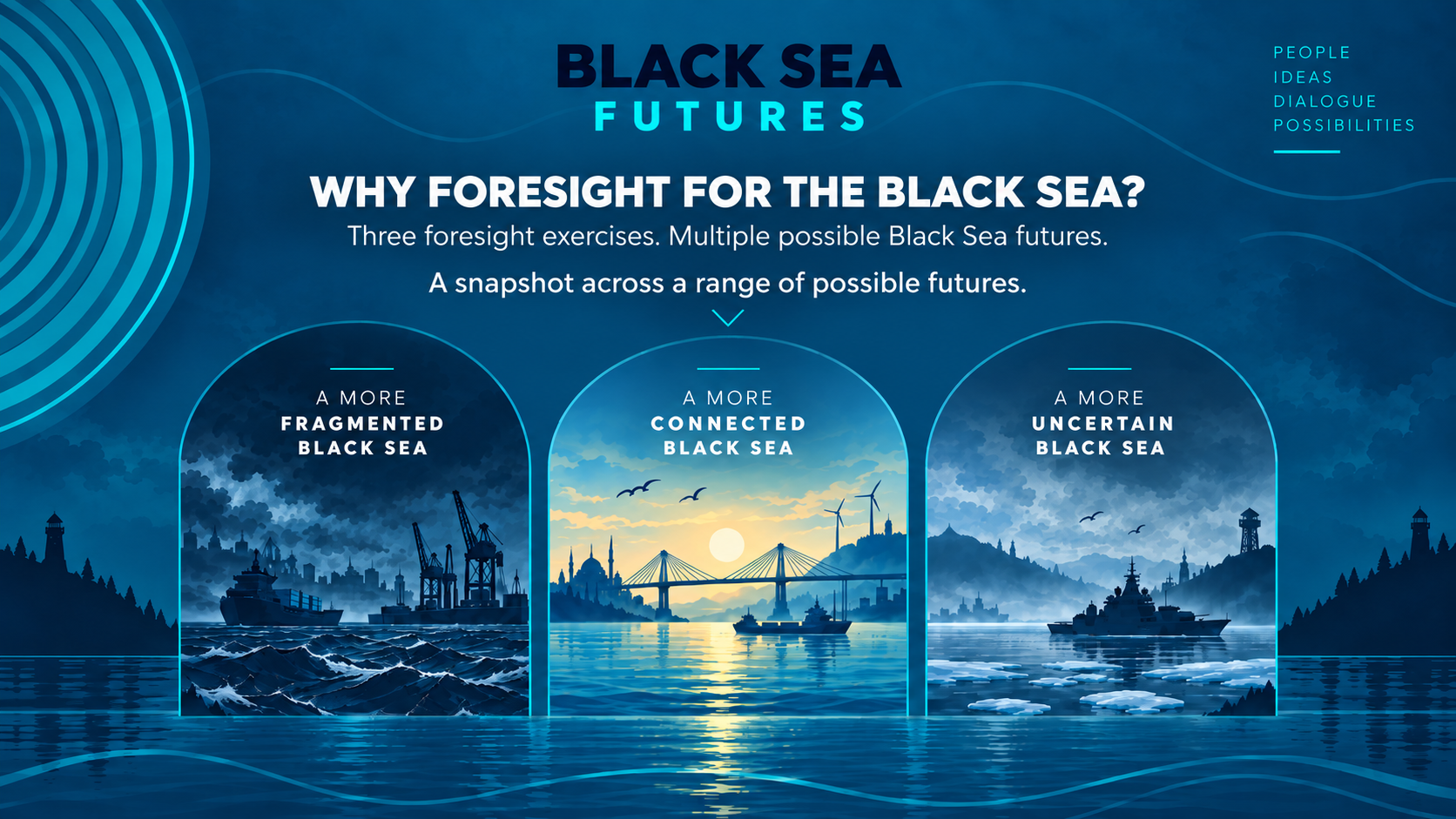
Therefore, three foresight exercises analysing the wider Black Sea region offer three different answers.
The Middle East Institute’s Alternative Futures for the Black Sea Region (2021) began with horizon scanning and distilled change into three drivers: alliance efficacy, infrastructure “tech-nomics” and societal accord. Their interaction produced four alternative futures for 2027: Muddy Waters, Compass Unmoored, More Walk, Less Talk and Let No Flowers Bloom. Its particular value today is temporal: the exercise predates Russia’s full-scale invasion of Ukraine. Reading it retrospectively exposes which assumptions survived, which were overtaken by events and which drivers remained relevant after a major discontinuity.
The EU Institute for Security Studies’ Four Swans of the Black Sea (2024) takes a much tighter security lens. Lake Interregnum, Russian Lake, European Lake and Frozen Lake explore different configurations of regional power and security towards 2030. Here, scenarios are used less to describe a desirable future than to expose contingencies for which European policy may need to prepare.
The Black Sea Trends (2025), produced by Ukrainian Prism for the Black Sea Security Forum, takes another approach again. It treats the region as a complex nonlinear system and uses trend-impact and cross-impact effects to construct three scenarios: Dead Water Drift, Choppy Waters and Riptide Zone. Rather than a conventional positive–neutral–negative spectrum, the scenarios are organised around different degrees of systemic stability.
Different methods produce different questions and at the same time illuminate different blind spots.
That is part of the value of foresight.
The test is not which scenario “gets the future right”. It is which assumptions become visible, which interactions we notice, and which choices remain robust across more than one possible future.
Resources:
- Middle East Institute – Alternative Futures for the Black Sea Region
- EU Institute for Security Studies (EUISS) – Four Swans of the Black Sea
- Ukrainian Prism / Black Sea Security Forum – The Black Sea Trends