
On 16 July, I joined an online session of the School of International Futures’ Long-Term Governance Network focused on network weaving – how networks are built, sustained and developed over time.
The discussion brought together practitioners with different experiences of creating communities around long-term governance, future generations and foresight. The examples ranged from building institutional partnerships with universities and professional associations, to citizen-led foresight initiatives designed to generate participation and trust from the ground up, to the creation of academic networks connecting research with practical policymaking.
One point that particularly resonated with me was that building a network is not only about bringing people together. It also involves questions of legitimacy, trust, purpose and scope: who the network is for, what holds it together, how participation is sustained, and how its areas of work remain sufficiently focused to be meaningful.
For me, the session was particularly timely. As I have been developing Black Sea Futures, I have also been looking more closely at how other organisations create spaces in which people working on related questions can exchange knowledge, learn from one another and gradually develop a shared practice.
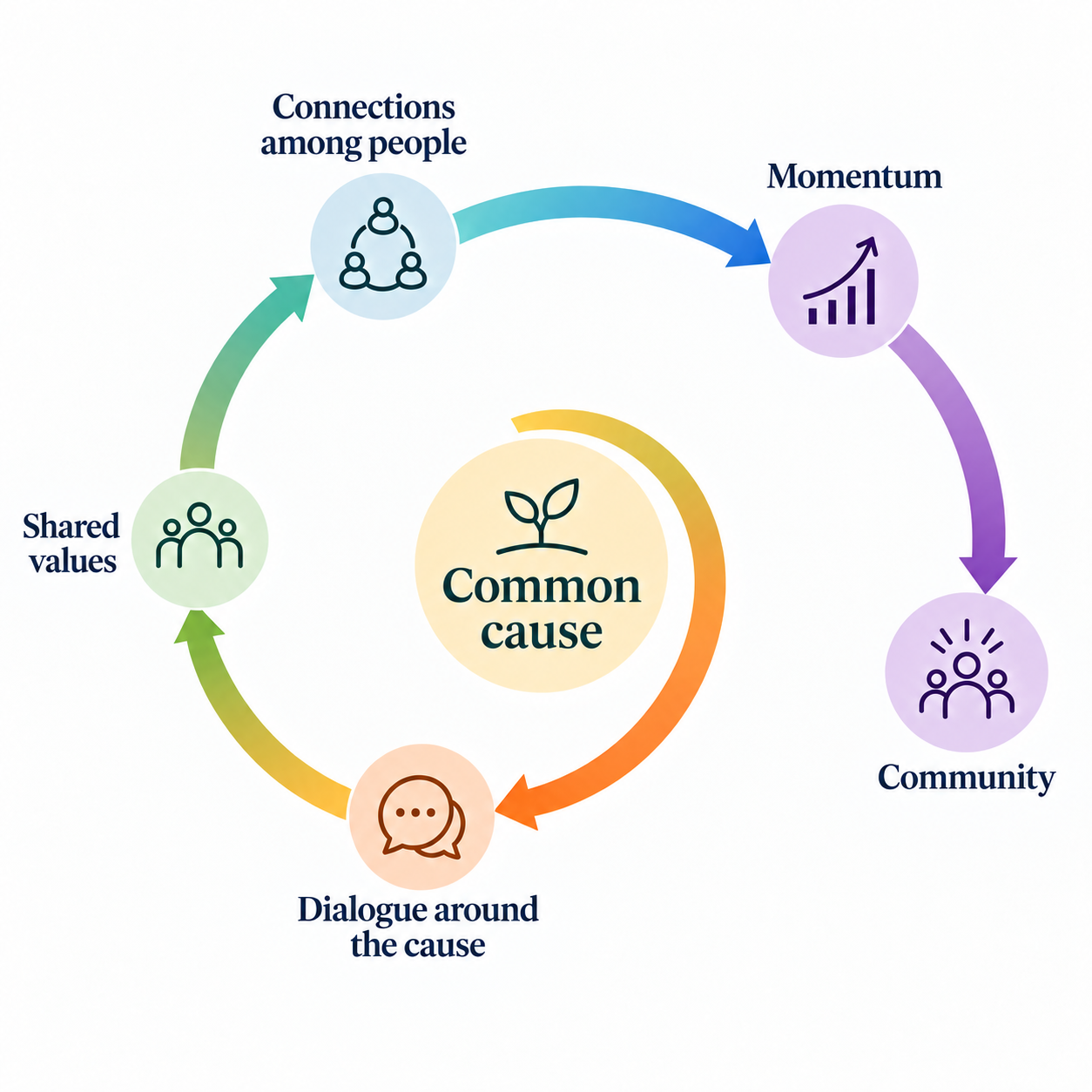
The discussion reinforced something that was becoming increasingly important to my own thinking: before there is a community, there is a common cause. The community gathers and takes shape in service of the common cause. That is the essential starting point. It is the common cause that gives people a reason to come together. From there, the task is to create a platform where people can communicate, exchange and build relationships around that shared purpose. In this sense, network weaving is about creating the conditions in which a shared concern can gradually become a shared practice.
Without a common cause, it is very difficult to create a meaningful community at all. From my own perspective, I would also stress the power of shared values: genuine connections between people are difficult to build without some sense of shared beliefs and principles, and a broader feeling of belonging around a common cause. That is what can give a community real purpose and drive.
In a nutshell, I would say:
Common cause → dialogue around the cause → shared values → connections among people → momentum → community