
Black Sea Futures · Critical Raw Materials
From Hydrocarbons to Critical Raw Materials: Can the Black Sea’s Strategic Resource Geography Support the Economy of the Future?
An overview of the Black Sea region’s critical raw material resources, evolving global dynamics, and what questions emerge for the future.
An introductory reflection and preview of the forthcoming Black Sea Futures series.
*This article is an English-language adaptation of an analysis first published in Romanian
by Europuls on 28 September 2026.
Overview
What might the wider Black Sea region look like twenty years from now? Critical raw materials, barely present in the wider public debate a few decades ago, are rapidly becoming central to the technologies and industries that will underpin the green, digital and defence transitions. Their supply chains are also among the most concentrated in the global economy, with China dominating at global level the refining of many key materials. Yet the wider Black Sea region possess resources that could give it a more important place in Europe’s emerging strategic economy.
This article therefore looks beyond the question of what resources lie beneath the ground and opens up a longer-term reflection around a question whose answer is still taking shape: to what extent could the Black Sea’s emerging critical-raw-material geography become a strategic lever of the economy of the future – sustaining the green and digital transitions, strengthening defence industrial capacity and reducing strategic dependencies – and what role could the Black Sea region play in that transformation?
01The strategic shift
For much of the post-Cold War period, the resource geopolitics of the Black Sea region was largely written in oil, gas, pipelines and transit routes. Russian energy exports towards Europe, Caspian resources, competing pipeline projects and access to the Black Sea helped shape economic relations and strategic dependencies across the region.
Russia’s full-scale invasion of Ukraine accelerated Europe’s efforts to reduce its dependence on Russian fossil fuels. At the same time, however, another transformation has been taking place: the green, digital and defence transitions are increasing demand for a different set of strategic resources – critical raw materials, including lithium, graphite, copper, magnesium, manganese, titanium, boron and rare earth elements.
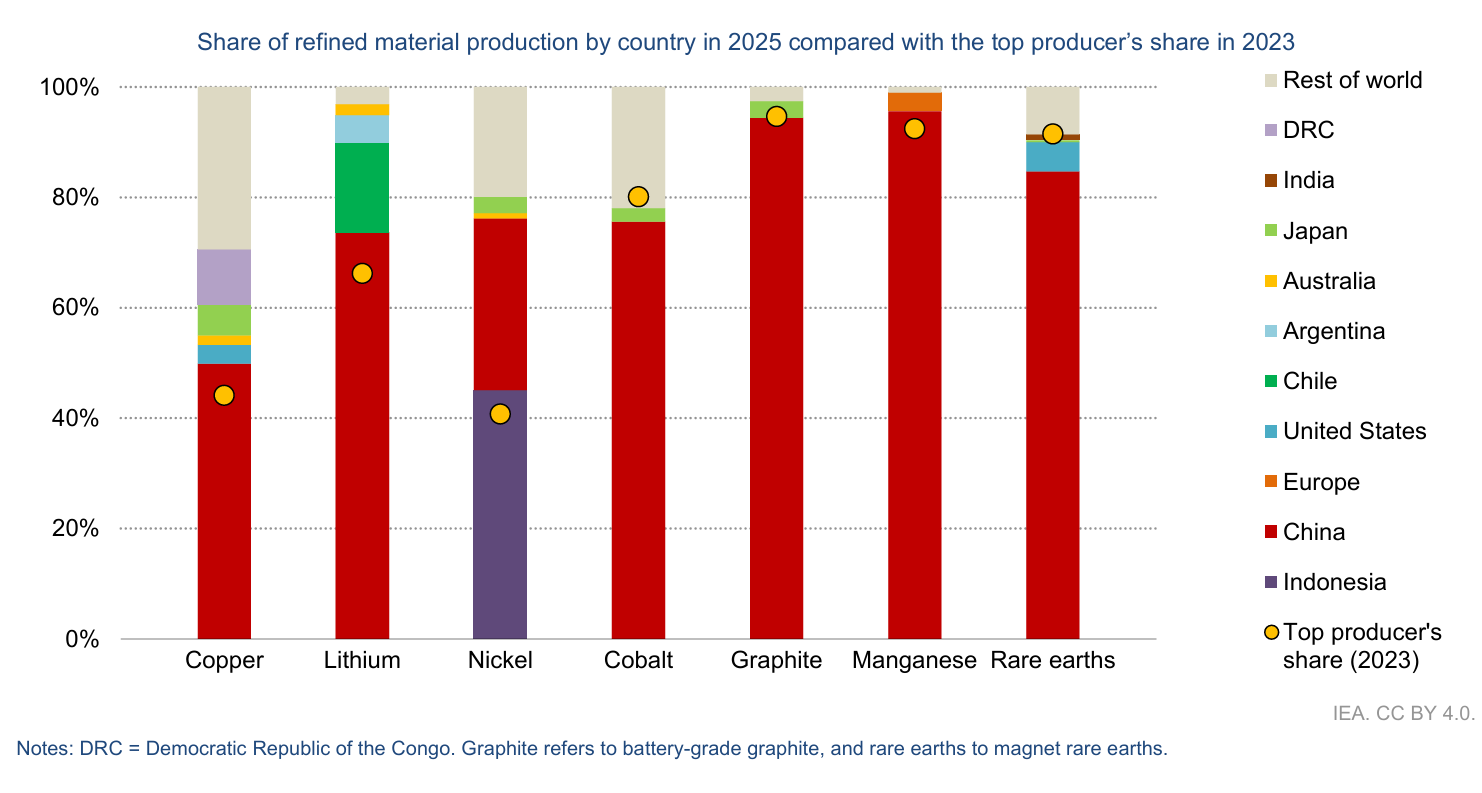
For the European Union, this is becoming an economic security question. The EU’s Critical Raw Materials Act aims to strengthen EU capacities “along all stages of the value chain”.[1] It sets 2030 benchmarks for EU extraction, processing and recycling of strategic raw materials and seeks to prevent excessive dependence on any single third-country supplier. The European Commission describes the supply of many critical raw materials as “highly concentrated”. Current dependencies remain striking: 99% of EU boron supply comes from Türkiye,[2] while China dominates several critical processing and refining chains.
But the crucial word is not simply mining.
It is value chain.
The long-term and strategic economic significance of critical raw materials will depend not only on what the Black Sea region possesses, and who exactly possesses them, but on how much of the economic activity surrounding those resources it is able to capture – from processing and industrial development to infrastructure, trade and higher-value production.
02Seen through a Black Sea lens, a new resource geography begins to emerge
Türkiye and Ukraine could become particularly important strategic anchors. Türkiye is already the world’s leading producer of boron and holds the world’s largest identified boron reserves[4]; its role as the EU’s overwhelmingly dominant supplier of boron already gives it an important position in European critical material supply chains. Ukraine, meanwhile, possesses significant deposits of lithium, graphite, titanium and other strategic materials. European Parliament research cites roughly 500,000 tonnes of lithium, major graphite resources and Europe’s largest titanium reserves.[5] At the same time, estimates suggest that around 40–50% of Ukraine’s mineral resources are located in territories currently under Russian occupation[6], adding a direct territorial and security dimension to the resource question.
Neither the EU nor the United States has waited for the end of the war to develop new critical materials-related partnerships and investment plans with Ukraine. The EU–Ukraine Strategic Partnership on Raw Materials and Batteries, launched in 2021, has the stated aim of achieving “closer integration of raw materials and batteries value chains”.[7] In 2025, the United States and Ukraine established a Reconstruction Investment Fund covering, among other sectors, critical minerals, hydrocarbons and associated infrastructure.[8] Ukraine contributes part of future revenues from new and qualifying resource licences, while the Fund is jointly governed; for its first ten years, “profits will be fully reinvested in Ukraine’s economy”.
Romania provides another piece of the emerging picture from inside the EU. Three Romanian projects have been recognised as Strategic Projects under the EU’s Critical Raw Materials Act: Rovina, focused on copper; SALROM Baia de Fier, on battery-grade graphite; and Verde Magnesium, on magnesium metal.[9] This places the Black Sea directly inside the EU’s effort to build more resilient domestic critical materials supply chains.
The South Caucasus adds a further layer when the Black Sea is viewed as a wider economic and connectivity space. Armenia is an important producer of molybdenum and copper – ranking sixth globally for molybdenum production in 2024[10] – while Georgia produces copper and manganese-related products. Azerbaijan‘s resource economy remains overwhelmingly centred on oil and gas, but it also produces aluminium, copper and iodine.
The long-term question, therefore, is not simply which country possesses which mineral. It is whether a region whose strategic resource geography was, for decades, organised predominantly around hydrocarbons and energy transit could gradually become part of a second geography organised around critical materials, processing, industrial supply chains and connectivity.
Yet this may not amount to a simple shift from one resource geography to another. Rather, the more important possibility is that the geography of dependency itself becomes more complex. Hydrocarbon dependence was often visible through suppliers, pipelines, transit routes and import shares; dependence on critical materials can be distributed across a much longer chain, from resource ownership and extraction finance to technology, refining and processing, transport infrastructure, industrial manufacturing and access to final markets.
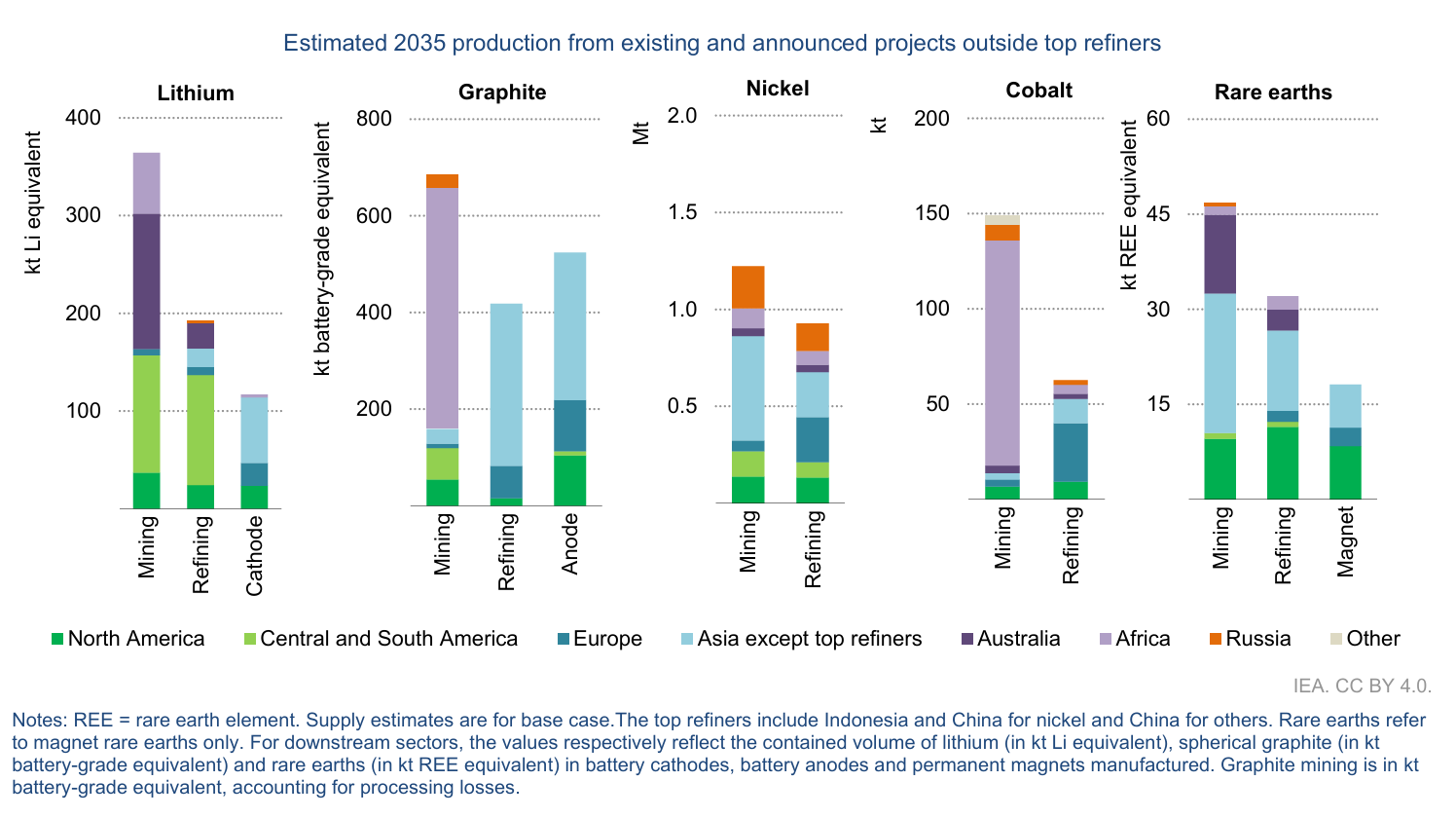
In other words, new critical materials resources may diversify some dependencies while creating or reinforcing others elsewhere in the chain.
03What to watch next: Who has the power?
That makes a different set of questions increasingly important:
Who finances extraction?
Who controls processing?
Where is value added?
Which technologies are required, and who controls them?
Through which corridors do materials move?
Which industries absorb them?
And which new dependencies are created as older ones are reduced?
These questions matter because possessing strategic resources does not automatically translate into strategic autonomy.
A country may hold substantial mineral reserves and still depend on external capital to extract them, foreign technologies to process them, infrastructure outside its control to transport them, or external markets to create demand. Resource endowment can therefore generate leverage, but it can also reproduce asymmetric relationships at different points along the value chain.
This, in turn, is why the question of industrial development matters as much as the question of extraction.
Will new mineral resources stimulate local processing and industrial development, or reproduce predominantly extractive economic models? Where will the higher-value stages of the supply chain be located? Could Türkiye’s resource position increase its economic leverage in its relations with Europe? Could Ukraine’s reconstruction and accession process draw European industrial policy further eastwards? How will US, EU and Chinese competition for secure supply chains affect investment and offtake arrangements? What environmental and social pressures could accompany accelerated extraction?
And, finally, could the transport corridors that increasingly connect the South Caucasus, the Caspian Sea, the Black Sea and the European Union[11] evolve into critical materials corridors as well? As these value chains develop, the region’s emerging transport corridors may also acquire greater strategic importance for the movement of critical materials between the South Caucasus, the Caspian, the Black Sea and European markets.
04Outlook
The Black Sea is unlikely to cease being an energy region. But critical raw materials could add a second layer to its strategic economic geography – one organised not only around the location of resources, but also around value chains, industrial capacity, connectivity and control over the higher-value stages of production.
The question is therefore no longer simply whether the Black Sea becomes a critical minerals region.
It is whether the region becomes principally a corridor of extraction, a site of value creation, or part of a new configuration of strategic dependency.
Its future strategic importance may increasingly depend on a much broader and nuanced question: what resources the region contains, who can access them, where they are processed, where value is created, how they move, and how they connect to the industries that will underpin Europe’s future economy and security.
05References
Numbered entries correspond to the citation markers used in the article. The linked document titles open the underlying sources.
- [01]Regulation (EU) 2024/1252 of the European Parliament and of the Council establishing a framework for ensuring a secure and sustainable supply of critical raw materials. The Regulation establishes 2030 benchmarks for EU extraction, processing and recycling of strategic raw materials and a diversification benchmark intended to limit excessive reliance on any single third country.
- [02]European Commission, Critical raw materials – Main global and domestic producers of CRMs. The Commission describes the supply of many critical raw materials as “highly concentrated” and reports that Türkiye provides 99% of the EU’s supply of boron.
- [03]International Energy Agency, Global Critical Minerals Outlook 2026, 16 July 2026. The report documents very high concentration in critical-mineral refining and shows that diversification challenges extend beyond mining into refining, manufacturing, technology, specialised equipment and industrial know-how, with refining and downstream capacity often lagging behind upstream mining.
- [04]U.S. Geological Survey, Turkey – 2024 Report. USGS identifies Türkiye as the world’s leading producer of boron when U.S. production is excluded from the ranking, and states that Türkiye was the primary producer of raw and refined boron and held the world’s largest boron reserves. Total reserves are reported at approximately 3.22 billion tonnes in 2024.
- [05]European Parliament Research Service, The future of rare earths mining in Ukraine, 27 March 2025. Drawing on the Ukrainian State Geological Service, EPRS reports approximately 500,000 tonnes of lithium, major graphite resources and Europe’s largest titanium reserves.
- [06]Council of the European Union, Ukraine: an investment in Europe’s future. The Council cites Ukrainian and international estimates according to which approximately 40–50% of Ukraine’s mineral resources are located in territories currently under Russian occupation.
- [07]European Commission, EU and Ukraine kick-start strategic partnership on raw materials, 13 July 2021. The stated aim of the partnership is to achieve “closer integration of raw materials and batteries value chains”. The Commission specifies that cooperation extends across the value chain of primary and secondary critical raw materials and batteries.
- [08]U.S. Department of the Treasury, Treasury Announces Agreement to Establish United States-Ukraine Reconstruction Investment Fund, 30 April 2025. The official source announces the agreement and describes the Fund’s purpose as mobilising investment for Ukraine’s recovery and the development of natural-resource projects.
- [09]European Commission, Commission Decision (EU) 2025/840 recognising certain critical raw material projects as Strategic Projects under Regulation (EU) 2024/1252. The Decision identifies the Romanian projects Rovina, SALROM Baia de Fier and Verde Magnesium.
- [10]U.S. Geological Survey, Armenia – 2024 Report. USGS ranks Armenia as the world’s sixth-largest producer of molybdenum in 2024, accounting for 3.2% of global production, and records substantial copper production and exports.
- [11]European Commission, EU launches Connectivity Agenda Platform to strengthen links between Europe and Central Asia through the Black Sea region and the South Caucasus, 23 June 2026. The Commission describes a cross-regional connectivity architecture linking Europe and Central Asia through the Black Sea region and the South Caucasus and covering transport, energy, digital connectivity and trade. The possibility that these routes could evolve into critical materials corridors is the forward-looking question posed in this article.